Tuesday, 12 August 2014

[A-Z Games] O: OutRun

Racing games are all about the feel and what works better than sun, Sega blue skies[1], a soft top, a bright red Ferrari and one of the most evocative soundtracks ever made?
OutRun was just outrageously cool and seemed to capture the joys of driving so beloved of advertising executives around the world. In my mind, I don't think there is a car more associated with the 80s than the Ferrari Testarossa and then with the blonde beauty on the arm - OutRun may have created that cliché for all I knew.
Racing games in 2D were not quite the same as racing games are now, being much simpler in terms of how you could control the car with a lack of real racing lines and suchlike. They compensated with creating an interesting world to drive through which Sega chose to showcase with a point to point branching structure. At the end of each stage (lasting about a minute) you could decide to take the left or right route in order to continue. Your decision was rewarded with a markedly different stage to keep it fresh. OutRun was about racing, for time, across the levels and so a lot of the challenge was overtaking non-competitors on the public roads that you were racing. Yu Suzuki (who may be the most important person in the development of Sega and coin-ops) does not describe it as a racing game, but as a driving game as it really is a thrilling drive rather than a race. With no competition, it is a time trial of sorts across a mixture of European themed landscapes.
Although there were plenty of versions and spin offs, it was only decades later that a sequel came to the arcades with the imaginatively titled OutRun 2.
This kept a lot of the same essence of OutRun but added a lot of modernity into the mix with 3D graphics and, more importantly, 3D gameplay. The intervening years brought a lot of change and Sega had become true masters of the arcade racing genre with games such as Scud Race, Initial-D and Crazy Taxi. These features were expertly added into the game along with a lot of love and attention to detail. Slipstreaming was now used so that you did not just avoid the other cars, you used them to your advantage - and received Crazy Taxi style points for overtaking close to other cars. The major addition, and the most important part of any arcade racer, was the new drift mechanic. Drifting in games (particularly from Ridge Racer) had transformed the approach of games and gamers to driving with high speed drifting seen as the way to show skill, get an adrenaline buzz and still have a varied environment for the background. Outrun retained the (as default) outside view for the car and so you could see the drift angles and it was a simple lift off the accelerator initiation so it was still impossibly cool. Games that can do that for the lamest of people - make players feel superhuman for even just a moment - get the point. A little like this PlayStation advert.
3 other O titles that might be interesting:
Okami, Beautiful collection of Japanese myths made into the most lush of adventures.
Omega Boost, A shooting game by driving game company behind Gran Turismo.
Operation Wolf - Light gun game that seemed to spawn a genre.


1. A great phrase that really does sum up a beautiful day. It also makes me think of Namco skies which are closer to dawn or dusk - though that may be mainly Ridge Racer Type 4.↩

Monday, 11 August 2014

[A-Z Games] N: Nights into dreams

Maybe more than other types of entertainment, games' popularity levels are hugely affected by the year of release and not just the season of release. In a somewhat related manner, the format of release is also very important and this split is not reflected in other entertainment media - we don't only buy books on 80 gsm paper, for instance. Nights was released in 1996 and was seen as a real driver for sales for the Saturn hardware, here was a new IP by the creator of the Sega IP: Sonic. The N64 was also released at a similar time and launched with the remarkable Mario 64 and so this could be seen as a true battle between the two companies. Could Sega win the battle of the platform game moved into the third dimension?
Anyone that has played Nights for more than a few moments will tell you that the comparison with Mario 64 is senseless as they inhabit very different spaces but that did not stop the comparison. And, for Nights, and by extension, the Sega Saturn, it was not a favourable comparison[1] and it is likely that many potential sales of the Saturn moved over to the N64 (in addition to the Sony PlayStation, partially due to Final Fantasy VII).
The game was not a 3D platformer, it was not a large, sprawling, hub-based world offering a glimpse into the future of gaming, it was almost a new genre though. Nights was simply a game where you flew collecting a number of jewels to unlock the next level - it really was as simple as that.

The slight problem, within the era, of Nights was that it was very replayable as a result of interesting mechanics and a compelling score attack system rather than having a lot of variety. The genius of the system was that you could collect the right number of jewels to unlock the next stage but you could then also fly around again and again collecting more for greater scores until you decided to fly to the next stage. The scores for collecting or passing through gates was also "linked" such that you would have your score multiplied if you could then get some more points within a time limit, so stringing together the points and allowing you to get massive chains together (there were also some infinite loop possibilities if you got very zen) and so massive scores. At this point in time, however, scores were falling out of fashion for a more narrative element in gaming.
Nights is designed in such a way that it is fun many years after with the scoring system still providing a wonderful risk versus reward structure. In fact, I am not sure there is quite a game like it although, to me, Jet Set Radio (my “J”) did feel a sort of spiritual successor. A lot of the quality in the game was also just purely from the joy of moving, that feeling of flight and control that came from the weight. Sonic Team were very good at creating that feeling of travel and the exhilaration of being in control of a ride which clearly came from the Sonic series.
I came a little late to the Sega Saturn and picked up a choice selection of games with the hardware within one second hand bundle. The Saturn, like the Dreamcast following it, had a number of excellent games drawn from Sega's arcade heritage and a very strong, cult, following so I was able to choose a lot of great games. When purchasing[2], the game I was after most was Nights as I had heard a lot about it and how it was a game truly in the upper echelons gaming.
Nights was never quite big enough to move beyond cult status but it did have a few strange releases to go with it, nonetheless. A magazine demo disc in the UK, though released in other territories, Christmas Nights was a short version of the game that was also released on the Saturn. Remakes were released on the PlayStation 2, PlayStation 3 and Xbox 360 along with an actual sequel on the Nintendo Wii. I would really recommend the PS3 version as it has the original port as well as a HD remaster although the controller can never match the classic beauty of the Japanese Nights Controller (or 3D controller as it was actually known).

3 other N titles that might be interesting: 
No More Heroes, - Retro and modern - a rare, proper feeling game on the Wii.
Nintendogs, - A virtual pet "simulator" that took over Japan on release - utilising a lot of the new features of the DS.
NARC - Side scroller from the Arcades. Winners don't do drugs.

1. For context, Mario 64 was a sensational, paradigm shifting game that very few games in history could stand comparison to. It was a rare 10/10 in UK magazine “Edge”.↩
2. At the time, I had joined an import gaming forum [link] called NTSC-UK which had a number of likeminded gamers that got games from the USA and Japan due to the different technical specifications of televisions there compared to the UK, hence the name. I learnt a lot through that forum but there is a specific Saturn story as I got to know a lot of guys and one, from Northern Ireland, offered to "chip and switch" my Saturn when he came over to London. This was a fairly simple process that allowed me to play games from all around the world and also switch between 50/60Hz which was the holy grail of gaming at the time. So, I met him at a central London hotel and went up to his room. He was a nice guy, we chatted about games, London and Northern Ireland and then he got to work on my machine. A few, short moments later there was a pop and some smoke. And a rather worried look on his face. I left with a broken Saturn. I cannot remember how this was resolved but a quick tidy recently seemed to show I had 3 Saturns lying about….↩


Sunday, 10 August 2014

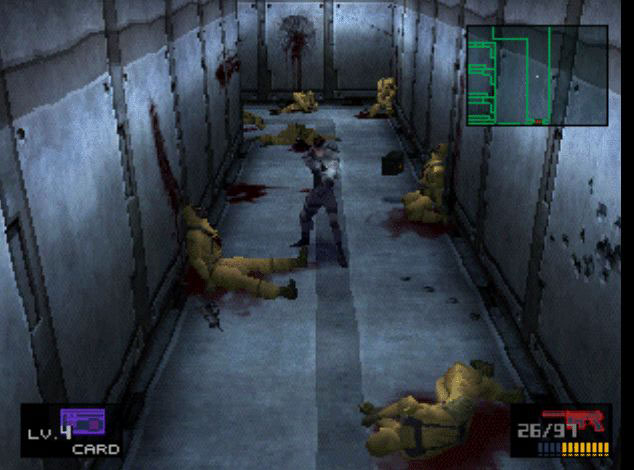
[A-Z Games] M: Metal Gear Solid

What a buzz this generated in 97/98. As far as I was concerned, this was a game with no track record but a huge level of love from the gaming press and I was intrigued. In fact, this was one of the first games I imported, picking up the US version with the bronze lettering (a rare occasion where the US box art was nicer than the EU, but not the Japanese one with silver lettering and the rotated cover. Of course.)
The thing that intrigued me, initially, about the whole thing was the idea of clearing levels without killing anyone (an idea played with quite brilliantly in the third Metal Gear Solid game with a river of death when meeting the Sorrow) which at the time was pretty groundbreaking. Games have always had what appears to be an unhealthy fascination with killing[1] and to have a game that wanted you to avoid combat and detection was a real shot in the arm to the industry and this stealth mechanic was a breath of fresh air (that became quite stale in the wrong hands, over time) at the time.
The game starts off with a drop into Alaska and one of the early stand-out moments for me was very early on with a helicopter flypast which used, seamlessly, the dual shock rumble effect[2] to simulate the helicopter - here was a game that knew what it was doing. In a post Final Fantasy VII world, the relatively brave decision to avoid FMV was also taken and all cut scenes (of which there are plenty[3]) done within the game world and using the game engine which is obviously not anywhere near as detailed as pre rendered video. This has, ironically, the effect of making the video more affecting and dramatic as you are not taken out of the game at any point. Yes, the characters may not have moving mouths, but it drew me in more.
The gameplay revolved around sneaking into a secret military base, Tactical Espionage Action, which meant avoiding security cameras and security guards until you reached a hostage. The sneaking elements were a revelation, they really were, and there were a number of great action set pieces that tied it all together that were much more typical of the action genre. It was a game with filmic pretension (which is not always appreciated but this was a different time where games were fighting for recognition) and this shown in the way the game is structured around big set pieces, the narrative style and the cut scenes. So here was a game that wanted it all, to have a relatively complex plot, to have the tone and style of a big budget action film, memorably vivid comic book style characters and then layer on gameplay mechanics that were all 100% game styled. I don't think anyone other than Hideo Kojima could pull this off, and nobody really has since then either. There is nothing like the Metal Gear series at all. And, it knows it. And it knows that it knows it. In such a way I am not sure other game directors get self aware and self referential. The game is peppered throughout with regular and classic breakings of the fourth wall. A school friend of mine that I lent the game to at the time, he told me he was stuck fairly early on. This confused me a little, he was a bright guy and almost certainly a better gamer than me so how could he be stuck? He said that he had to find the radio frequency but he could not find the CD case anywhere.
I said “I gave it to you”, which then prompted a confused look.
“It is on the back of the actual CD case, the game box....”
“Oh my god, how did I not think of that?”
Each of the “levels” in the game is essentially leading up to a boss fight in the same way that you would expect of games but you need to pick up different weaponry to keep progressing (in many ways, this feels like a Zelda system of progression) and the bosses usually end up giving you a keycard to unlock the next section. In terms of breaking the fourth wall, the prize has to go to Psycho Mantis who may be my favourite of all videogame characters. As a powerful psychic and spiritual medium he can use the powers of mind reading and telekinesis to play games with your mind. Everyone thinks something is wrong with the console when they reach him as he makes you question what you are seeing and also unquestioningly do his bidding[4] . You don't play Psycho Mantis, he plays you.

I could talk about Metal Gear Solid and the sequels ad nauseum (maybe I already have....) but this was a defining moment in games, of that there is no question. The prequels which I had not heard of also had ideas way ahead of their time and ideas above their station too. I can only wave my hands in the general direction of the astonishing artwork by Yoji Shinkawa that put real life and soul into the world and the promotional stuff.
What a game series. One of a kind and there really is nothing like it.

3 other M titles that might be interesting: 
Minna No Golf - One of the purest feelings in games with a very direct feeling golf game.
Manic Miner - Classic 8-bit platformer 
Mario Bros. - The start of a franchise? The single screen game that many have forgotten.


1. This is due in part, historically, to the technical limitations of keeping unnecessary, or “dead” items on screen and then having to use computing power for them even though they do not add to the game.↩
2. The N64 controllers had an optional Rumble Pak to be added to the system later in order to add more immersion to games. Sony followed suite, eventually, with a Dual Shock controller which had both analogue controllers and vibration motors which were still quite new when Metal Gear Solid was released brought in.↩
3. A regular jibe against the series is the length of these cinematics and there is a school of thought that says games should find gameplay methods to tell their stories which I usually agree with but Metal Gear is above criticism. Often, the way this is done in modern games is to have the story still told by non-playable characters within the game but have you still able to walk around but for no reason at all.↩
4. This is undoubtedly a spoiler: In the battle with Psycho Mantis, he proves his telekenisis powers by asking you to place your controller on the floor which he makes move with his mind. Even as you are doing it, you know what is  happening but you still do it. This has to be the purest of examples of cognitive dissonance and a willing suspension of disbelief in games. Once the battle starts, and he has shown off enough, he seems to be untouchable and then he just turns the TV off. Your TV. The screen goes black and you get the “video input” sign on your TV. I got up to check and then the normal screen comes back and he is hurting you. It is quite the mind blower and I am not sure a single moment will ever quite touch the purity of that feint in battle.↩

Wednesday, 6 August 2014

[A-Z Games] L: Little Big Planet


LittleBigPlanet is a platform game but, in many ways could also be thought of as a game platform. As a platformer, it is a relatively simple but has a lot of charm. The aesthetic is that of a homespun toy box with lots of cardboard cut outs, different materials and stickers. In many ways, it resembles a scrapbook or the gallery from Tony Hart art programmes (and also uses the same music in the prologue). And this home-made feel is carried throughout the game with characters and levels made up of strange combinations of things that happen to be lying about. It is a great feel and seems perfect for the PlayStation 3 which has enough power to show this all but without trying to make it too detailed. It was a hugely charming game with a lot of character for the main protagonist, Sackboy. As it was multi player, with up to 4 players both off and online, each of your characters would also need to be differentiated so you could dress your sackboy up in curios that you picked up - and this level of personalisation was throughout the game. Your home, or hub, could also have stickers on it, you could take pictures and stick them up at home and lots more beside. The floaty physics were a little off-putting for me at first (not as tight feeling as Mario) but once you got used to it, the world was entirely consistent and the platforming both fun and interestingly different. As a 2D platform game, it added some layers into the mix and you had three planes in the z-axis that you could also use.
I wonder if people remember Web 2.0, or more pertinently Web 1.0. The original "web" was a world of static pages and authored content about, usually, fairly niche interests as it was aimed at the kind of people that used the web at the time. Web 2.0 was about creating some form of dialogue with your readers - except they stopped being readers and became users. User generated content. Like the explanation for selling soap to rich people in Fight Club[1], the secret was to make people pay and then work for their own enjoyment.
LittleBigPlanet was the gaming equivalent of Web 2.0 - the level editor was almost as anticipated, if not more so, than the game itself. Using a simple editor, which was very similar to the game, you could design levels with the same graphical fidelity as the levels within the game and the same levels of complexity were possible. A number of different switches and music "traps" were available to add colour and sound to the world so you could let your imagination run riot. Like Minecraft after it, some of the more popular creations were really recreations of other worlds and homages to other games and films. Who knows how many versions of Super Mario Brothers levels were made? Once made, the act of publishing was very simple and then, like a YouTube video, it was ready for anyone in the world to play with. It was a great explosion of the design world and it became a type of game platform.
A billion monkeys with a billion typewriters might be able to come up with the Complete Works of Shakespeare but what they are more likely to come up with is what we see on the Internet these days - but with fewer cats. And LittleBigPlanet levels were often like this, really dull with little of note, but the better levels were well thought out and a great exploration of the medium. A few sites attempted to curate them with mixed success. There was also a "scene" of people composing music videos and I particularly liked some of the Spirited Away ones. The series has continued with the same charm and fun with a number of instalments on the PS3, PSP, PSV and PS4 but it may have set the world up to be able to become ready for Minecraft and the creativity that has unleashed. 

3 other L titles that might be interesting: 
Last Of Us - Maturity in games can often be a bit misconstrued, but not always.
Link's Awakening - Zelda games work on the small screen – and this one really worked.
Lemmings - A puzzle game of saving cute little animals – quite atypical at the time.

1. Tyler sold his soap to department stores at $20 a bar. Lord knows what they charged. It was beautiful. We were selling rich women their own fat asses back to them.↩

[A-Z Games] K: Katamari Damacy

Sometimes you just need some outside influence to get things moving. 2004 was not a difficult time for the games industry, the PlayStation 2 was riding high with solid, and differential, competition in the form of the GameCube and Xbox. The shocks of the Nintendo DS[1], and PlayStation Portable were yet to come and publishers were going through a series of cash cows yet Namco decided that a risk was necessary which came from a Namco sponsored university.
Keita Takahashi created and developed Katamari Damacy but at the time he joined Namco, he didn't even own a PlayStation.
Here was an unashamedly quirky game, with the aim to roll up everything you could see. And for once, everything was pretty close to the reality of it.
It was rubbish, yet brilliant. Placed behind a small ball with attractive powers, you had to roll a ball of rubbish (well, items you had picked up) bigger and bigger until... it was big enough. Your motivation for doing so? So that the King Of All Cosmos would praise you, a little, and so that he could repopulate the universe with stars. It didn't really make much sense in each part but it all made sense together and it was a terrifically different game and seemed to take a path away from the well-trodden route. Here was a game that had simple controls (using both analogue sticks like a tank controls), a very easy to understand mechanic and simple, clear graphics. As games consoles evolved, they generally became more complex with more options to control and fewer opportunities to learn how to use them in playful environments. It was a casual game before they really existed (and not casual as we understand it at all) as it was accessible and it tried to be nothing other than a game. Each level asked you to create a ball of stuff up to a certain size (if you surpassed it, you opened up the next level but you could keep going, score attack style, until time was up) from wherever you are. Starting off in a house, you can roll up bits of food, batteries, shoes etc until you get bigger and bigger. As your ball gets larger, you can start rolling up larger items so that the items, such as a plate of noodles, that you once rolled over, will now become part of your ball. It is a simple system that anyone can get. And it is kind of fun, but also a bit humdrum after a while until, until, you get large enough to pick up cats - and then dogs. And then people. Every single person I have persuaded to play this has really, visibly, perked up once they can pick people up - at that point it becomes compelling[2]. Worryingly.
It does not stop at people and soon there are bikes you can roll up, and then cars, and then trucks and so on and so on until you can pick up complete buildings. It is great fun, bringing to mind classic monster movies and games such as "Rampage".
To go with the simple graphics and charming narrative and characters was an excellently varied soundtrack of in-house music.
At a time when the shift to more realism (and away from the Japanese development teams) seemed to be started, this was well appreciated by many and the game did very well in Japan on domestic release. It did well enough without the big marketing or development budget to see a later release in North America and Korea but not the UK (although a sequel was released and later versions have been released in Europe too). Arguably, the success may have partially created the casual boom of the next few years as simple controls became de rigeur with touch screens and motion control. Maybe it didn't, and maybe all the wrong things were taken from it, but I can't help but feel it was a waypoint of sorts.
It's great that there are many types of videogames, but I've always wanted to create something different that can only be done in a game. If you are going to play a game that resembles a movie, you should just watch a movie, and if you are going to play a game that shows realistic cars, wouldn't it be more fun to drive a real car?
3 other K titles that might be interesting: 
Killer Instinct - When all arcades needed overblown beat 'em ups, here was the competition for Mortal Kombat - but not Capcom. 
King of Fighters '98 - When all arcades needed overblown beat 'em ups, here was the competition for Capcom - but not Mortal Kombat. Technical, SNK.
Killer 7 - Part of the GC Capcom 5, a stylish if slightly offbeat take on the shooter games.

1. I have a personal theory that one of the worst things to happen to the games industry, in Japan especially, was the success of the Nintendo DS in expanding the market. I lived in Japan at the time of release and the DS was ludicrously popular. I saw it being advertised everywhere and I saw it on public transport all the time but, in hindsight, I am not sure I saw it being played all that often. The two games I remember most strongly were Brain Training and Nintendogs - both of which did very well indeed and, arguably, neither were really games in the widely accepted sense of the word. At this time, the games shops were full of DS games in a similar vein, those that were casual - things like spot the difference, dictionaries etc etc. These "games" were so simple to make, cheap to create and requiring almost no thought within the development phase (I am not denying that some of these games, especially the Nintendo games such as Nintendogs, were not carefully and lovingly crafted) that it seemed silly for publishers to not chance their arm. Why spend time and effort on a new game with carefully balanced gaming mechanics if the simplest of games could sell more copies? And so, it all fell apart. This is just my opinion though and a footnote is not somewhere to expand on it!↩
2. And obviously, you can pick people up only depending on their size so you can first pick little people up. Or children, as they are often known.↩

Tuesday, 5 August 2014

[A-Z Games] J: Jet Set Radio

Effectively a new genre, and a brand new aesthetic style with a great soundtrack, Jet Set Radio is one of the greats.
At the dawn of the new millennium, Sony had fundamentally changed the gaming landscape within the short time after they had released the PlayStation and as graphics improved, games moved towards a realism paradigm (which is not, necessarily realistic but tries to look like it) which was more "mature". Sega's Saturn had been pretty comprehensively routed in sales terms and they went back to the drawing board with the release of the Dreamcast which was far more powerful than the Sony PlayStation (but, crucially, not more than the PlayStation 2 that was to come) and designed to be easy to develop for and also a 3D capable machine. Sega's differentiation strategy was to draw on their arcade heritage (and ongoing success at the time) and bring those bright, bold colours to the home which was achieved with a string of arcade-perfect conversions such as Sega Rally 2 and Virtua Fighter 3.
In 1999, Sega developer Smilebit announced the remarkable looking Jet Set Radio - a cel-shaded (a term that had yet to really be defined) rollerblading game set in a cartoon Tokyo. It looked fantastic with bright, crisp images and a smooth animation style that popped out of the screen. That same year, Tony Hawk Pro Skater had made skateboarding games popular and this seemed to ride on that with a simple copy but with some extra Japanese craziness. This turned out to be not quite right as the trick mechanic seemed to be massively downgraded and the game a shallow facsimile. Except, those preconceptions were not right at all - this had little to do with the Tony Hawk gameplay - this was a classic Sega combination of score attack and arcade simplicity made whole with clever, tight design. Tricks and suchlike were not the meat of the game - you could play without tricks at all but they were there for you to enjoy if you felt like it. Entirely superfluous and vital at the same time. In order to complete a level, you had to "tag" with graffiti a set number of sites around the level within a time limit. As you tag more areas, the level of defence from the police and other gangs increases so you have to plan your route to avoid them where possible. At the time, it was a game that I felt was was both fundamentally retro in nature yet also cutting edge[1]. It revolved around learning the simple mechanic, and then learning the map and putting together a strategy that allowed you to get all tasks done effectively and efficiently - and in that sense it reminded me a lot of the criminally underrated Nights. There were no power ups, there was no emotive progression of your characters with unlocked skills etc - this was a clear case of level design showing progress. And, actually, many of the levels were recycled as you revisited areas but when you design them well, they don't get tired. Based on areas of real life Tokyo but not slavishly copied allowed the designers to get the feel for the space (as I found when I got lost once, in Shibuya) and keep design appropriate for the gameplay. I wish that this method, rather than copying real life, was a method used more often.
The very first level set up as a tutorial sets the game up very well with the ideas of speed, combo chains and grinding set up well enough in a bus station level. The tutorial introduces all of the concepts of the game and asks you to create quite a long "chain" by grinding and jumping over a number of railings until you realise that there is an infinite loop there and that sets the whole of the game up to be one of spotting opportunities.

Arguably, this was the Dreamcast's finest hour - the game that there was never a competitor for, in any way, on any other console[2] and that was kind of indicative of the problem. A problem that Sega never overcame and would, in my opinion, eventually overwhelm the Japanese games industry. The problem being that tight, repeatable design was on the way out[3] to be replaced by sprawling, open worlds. And the reason there was no competition was that it was not selling - great games developed into a cul de sac - a beautiful, playable cul de sac.
The soundtrack, by Hideki Naganuma and largely created in-house (as was usually the case then) is genuinely exceptional with a smattering of licensed tracks, such as Improvise by Jurassic 5,  adding to the variety and quality. From a technical, artistic standpoint, this is a truly coherent whole.

3 other J titles that might be interesting: 
Jak & Daxter  - 3D platformer series in the Mario mould.
Jungle Strike  - The isometric helicopter genre did not have many more instalments - even though EA love franchises.
Jet De GO! - An airliner simulator based on the Densha de GO! Model, which is less unfairly maligned.

1. In fact, I bought this, rather shamefully, within the Dreamcast death rattle phase when you could buy it with four games included for a small sum. There were some great games available and it is a real shame that the potential of the PlayStation effectively killed the realised potential of a group of developers at the heights of their powers. The Dreamcast remains a beacon of hope, and despair, in the history of the industry. Its failure destroyed Sega as it tried to reach beyond what it could and soon, you could buy Sega games on Nintendo hardware - a previously ridiculous proposition.↩
2. The sequel, Jet Set Radio Future was released on the Microsoft XBox.↩
3. It would return, eventually, in the form of the ubiquitous online battle arenas that FPS games would make their own.↩

[A-Z Games] I: ISS Pro Evolution

Football is definitely a love of mine and my interest in it has helped me, socially, so many times. It is so easy to connect with people across the world with it.
My favourite game of all time is Sensible World of Soccer which I had on the Amiga but when I got a PlayStation there seemed nothing of a similar quality, or even close. I got a copy of Actua Soccer (clearly a play on words on the ongoing Virtua series of games from Sega) and still played it but with a conscious realisation that it wasn't that good. I heard of a new game called ISS Pro coming out which looked great - a good friend of mine told me that I should be excited as he had ISS on the SNES and loved it. At a similar time, there was also a ISS game on the N64 that played very differently[1] - a little more manual with the 360º control but also seemingly quicker and more arcadey. ISS Pro was a very good game with a set of nice likenesses to the players but without the licences to use real names. The look and feel was quite bold and arcadey but also a lot of fun and the through ball mechanic was great and quite new to me. 
A few years later came ISS Pro Evolution[2] at about the time of Euro 2000. It seemed slower, more deliberate and not as good - for about ten minutes. In a wonderfully circular way, I was now at university with the same person that had initially told me to get excited and playing together, it was obvious that the game had definitely evolved and could now be considered a true great. The teams and players had real personality with differences in teams feeling more obvious. From this point on, in football games, I did not change teams' formations and tactics drastically from reality and expected to play in that way. For me, it was at this point that a true legend was born. The different styles that you could use to win (or frustrate for a draw) were superb and the variety seemed to match that in the real, beautiful game with low scoring, hard games the norm and each goal really counting for something. A turning point was the same friend frustrating my possession game with a defensive display as Paraguay and scoring once on the counter[3] . That is what football is all about. 
It was not from this point that real player names were added but this really added to the immersion and the players resembled the stars of the game quite closely. The number of options around the formations and strategy were ramped up massively and you could choose to play in particular ways with certain teams - great at playing in certain ways. I used to have a soft spot for the Croatian team with the silky midfield of Boban and Prosinecki, for example. This version of ISS has provided the template that Konami have built from and so can be seen as the real genesis of the series - it was appropriate that they changed the name at this point slightly. EA would also, effectively copy this model of football game and tweak it to add real gameplay to the raft of licences in the all-conquering FIFA series.
The series has continued with yearly updates and has continued to evolve in its own way but the revolution came with evolution.

3 other I titles that might be interesting: 
Ico - Actions and emotions speak louder than words.
IK+ - Simple, quick and tight fighting game with falling trousers. 
Internal Section - Musical shooter, before such things were known of (i.e. pre-Rez).

1. I later found out a lot more about the series and the Japanese versions which were, sensibly, given different names - Winning Eleven by KCET and Perfect Striker by KCEO. I can only assume the marketing people in the west thought it would be more confusing.↩
2. I kind of miss the days of Japanese developers making games with longer, and more outlandish prefixes and suffixes.↩
3. Later, I moved I the slightly different Japanese Winning Eleven of which Winning Eleven 6 (for the 2002 world cup) was a highlight. My favourite point being when another friend would come to play and we had “rival teams” of which one set was England vs Italy. He had a rule that he couldn't leave on a draw, however late it was and so when it was a 0-0, he stayed. Five excellent 0-0s later, he scored a late, late winner. This is what brings the joy of the game home to me.↩